Agentic AI: The Dawn of Autonomous Intelligence

Artificial Intelligence is evolving from responsive to self-directed. Agentic AI represents the next era — systems that perceive, decide, and act autonomously. Discover how Yugensys is engineering the foundation of autonomous intelligence, where machines move from following instructions to driving intelligent, real-time decisions on their own.

Table of Contents

Speed Is an Architecture Decision

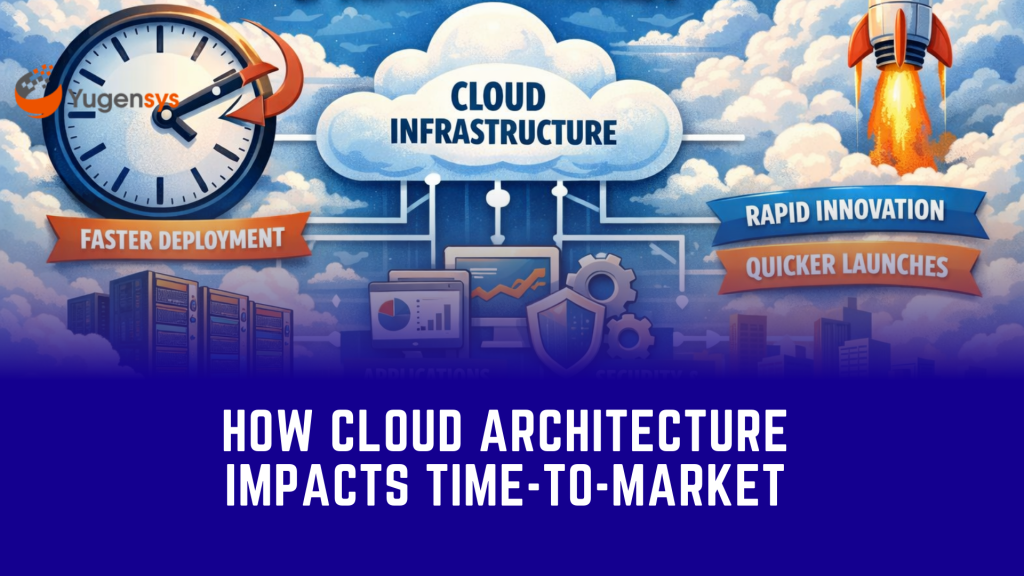
Time-to-market is often framed as a delivery issue. For leadership, it is more so an architecture decision.

Organizations slow down when platforms are hard to change, releases require leadership sign-off at every step, or early design choices limit later decisions. In these situations, speed is limited not by execution effort, but by the cost of change. Cloud architecture affects time-to-market by lowering that cost and allowing business priorities to be acted on without structural delays.

When cloud foundations are designed with intent, releases shift from infrequent, high-risk events to smaller, predictable updates. Changes can be introduced without reworking core systems, which gives leadership clearer timelines and the ability to respond to market or customer signals without disrupting ongoing operations.

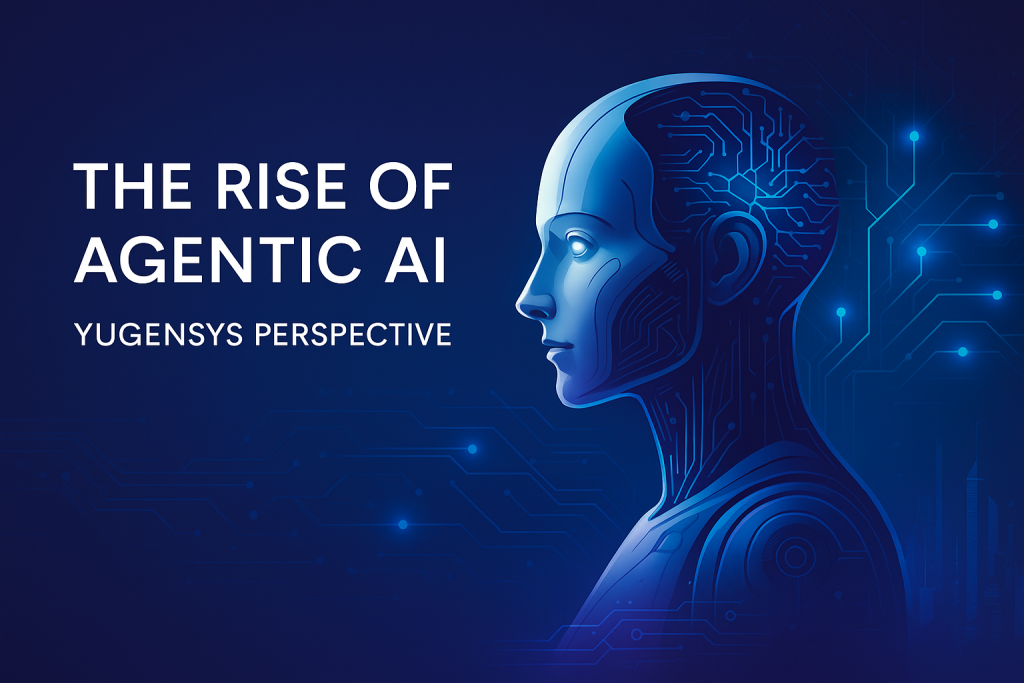
The Rise of Agentic AI - by Yugensys

Faster Releases Through Better Risk Management and Consistency

Cloud architecture also reshapes how risk is managed. Performance, scalability, and reliability issues are identified earlier in the lifecycle, when they can be resolved without last-minute trade-offs. This reduces late-stage surprises and makes launches more controlled, rather than compressed under pressure.

As organizations scale, speed alone is insufficient. Consistency becomes a leadership requirement. Cloud-based platforms enable common delivery patterns across teams and regions, reducing dependency on individual execution styles. For CXOs, this translates into greater predictability across initiatives, better portfolio-level planning, and fewer delivery escalations.

Yugensys View: Architecture Aligned to Business Outcomes

In practice, Yugensys has seen time-to-market improve when architectural choices are made with business outcomes in mind, not treated as mere implementation. Across product launches and modernization programs, this has typically resulted in:

    • Platforms structured to validate direction early, allowing leadership teams to confirm priorities before committing significant time or capital

    • Existing systems updated in specific high-impact areas, so releases become faster and more predictable without disrupting stable operations

    • Cloud foundations built to support growth when it occurs, rather than forcing premature investment

    • Cloud architecture does not guarantee speed. But when aligned with business priorities, it removes many of the reasons products fail to reach the market on time.

At Yugensys, this alignment is treated as a discipline – one that helps leadership teams move with confidence, not urgency.

Our Services

Book a Meeting with the Experts at Yugensys


Subscrible For Weekly Industry Updates and Yugensys Expert written Blogs


More blogs from Data Infrastructure

No description found for this category.

Agentic AI: The Dawn of Autonomous Intelligence

Artificial Intelligence is evolving from responsive to self-directed. Agentic AI represents the next era — systems that perceive, decide, and act autonomously. Discover how Yugensys is engineering the foundation of autonomous intelligence, where machines move from following instructions to driving intelligent, real-time decisions on their own.

Table of Contents

Artificial Intelligence has evolved faster in the past three years than in the previous three decades.

From conversational models to decision-making systems, AI is no longer confined to analysis or automation — it’s moving toward autonomy.

This evolution is giving rise to a new class of intelligence — one that doesn’t wait for human prompts. It acts with purpose.

This is the foundation of Agentic AI — the frontier where machines become proactive collaborators rather than reactive tools.

The Rise of Agentic AI - by Yugensys

From Reactive Intelligence to Autonomous Action

For years, AI systems have been reactive — answering queries, processing data, or following human prompts with remarkable accuracy.
They have accelerated efficiency, yes — but always within boundaries defined by human intent.

That paradigm is now changing.

The next generation of artificial intelligence is learning to act on its own — to perceive, plan, and perform without waiting for a human trigger.

Welcome to the era of Agentic AI — where machines no longer just respond to commands, but decide what to do next.

What Makes Agentic AI Different?

Traditional AI models are static: they classify, recommend, or predict within a predefined scope.
In contrast, Agentic AI systems are dynamic, continuously observing their environment, adapting their strategy, and acting toward goals — much like a human decision-maker.

An Agentic AI is not a single model, but an ecosystem of models, logic, and reinforcement loops that allow a system to:

  • Interpret data contextually

  • Evaluate multiple possible actions

  • Choose and execute a course of action autonomously

  • Learn from the outcome and refine its future behavior

Think of it as moving from “AI that answers” to AI that anticipates.

In a business context, this means a system that can not only detect an issue — but also solve it in real time.

Architecting Agentic AI Systems: The New Engineering Stack

Building an Agentic AI solution requires a rethinking of the entire software architecture — from data pipelines to deployment orchestration.

At Yugensys, we describe this evolution as moving from AI-enhanced systems to AI-centered systems.

A modern Agentic AI stack typically integrates:

  1. Perception Layer:
    Continuous input from sensors, databases, and APIs to observe state changes and detect anomalies.

  2. Cognition Layer:
    Decision models (often multi-agent LLMs or goal-based planners) that reason over data and determine optimal actions.

  3. Action Layer:
    Orchestrators or workflow engines that can execute the chosen actions autonomously — triggering APIs, workflows, or robotic systems.

  4. Learning & Feedback Loop:
    Post-action evaluation mechanisms that reinforce or adjust behavior for future decisions.

In essence, it’s closed-loop intelligence — the system perceives, decides, acts, and learns without requiring manual intervention.

Real-World Applications of Agentic AI

The transition to Agentic AI is already underway across multiple industries.

1. Customer Experience (CX) and Operations
Agentic customer support copilots can autonomously classify issues, trigger service actions, or route tasks to the right departments — no escalation needed.

2. Manufacturing and Industrial Automation
Systems that detect inefficiencies, trigger maintenance, and rebalance production lines — optimizing throughput without waiting for approval.

3. Healthcare and Life Sciences
AI agents that monitor patient vitals in real-time, flag deviations, and initiate clinical protocols or physician alerts automatically.

4. Enterprise Resource Optimization
Agentic systems that continuously analyze team workloads, forecast bottlenecks, and reprioritize projects — aligning resources dynamically.

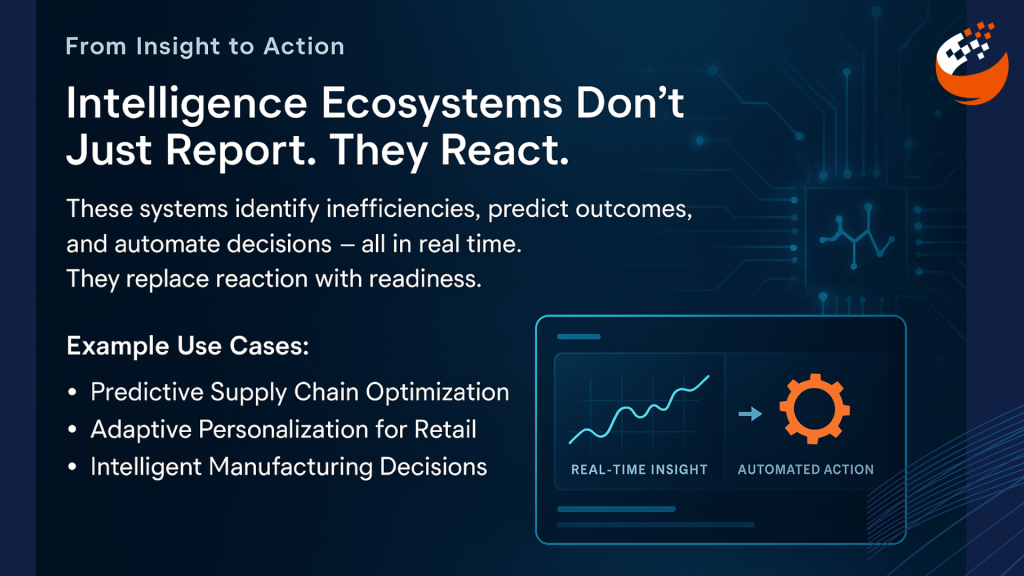
Each use case has one common thread: proactive intelligence that removes latency between insight and action.

The Human + Machine Equation: From Control to Collaboration

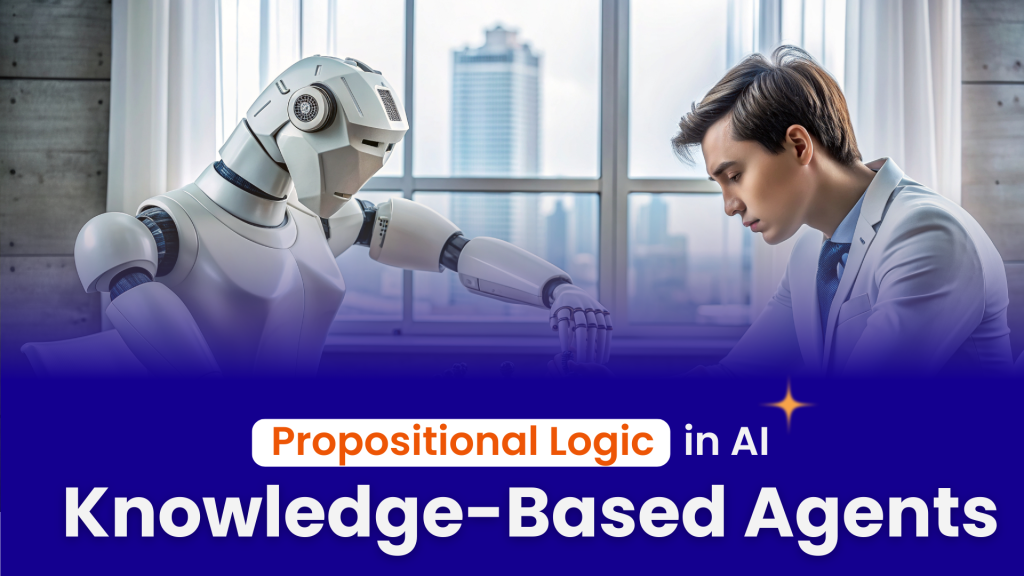
Agentic AI does not eliminate the human role — it redefines it.

Where traditional automation focuses on replacing repetitive tasks, Agentic AI focuses on augmenting human judgment and extending decision reach.
It allows humans to set objectives, not micro-manage execution.

At Yugensys, we call this Decision Layer Decoupling:
humans define what success looks like; AI systems determine how to achieve it.

For example, in financial services, a human sets the goal — “minimize risk exposure within compliance limits.”
An Agentic AI system then autonomously evaluates market data, adjusts portfolio allocation, and executes micro-decisions in milliseconds — learning from each iteration.

The outcome?

  • Humans lead direction.

  • Machines drive optimization.

The Organizational Shift: Preparing for Autonomous Intelligence

To successfully integrate Agentic AI, enterprises must undergo both technical and cultural transformation.

  1. Architectural Readiness
    AI must move from siloed applications to centralized decision layers integrated into business workflows.

  2. Data Integrity and Governance
    Agentic systems depend on real-time, reliable data streams — and transparent guardrails to ensure accountability.

  3. Operational Alignment
    Teams must evolve from monitoring systems to partnering with systems, interpreting AI decisions and refining objectives.

  4. Trust and Transparency
    Building human trust in autonomous systems is crucial. Explainability, traceability, and ethical AI frameworks must be embedded into every layer of development.

The shift to Agentic AI is as much an organizational revolution as a technological one.

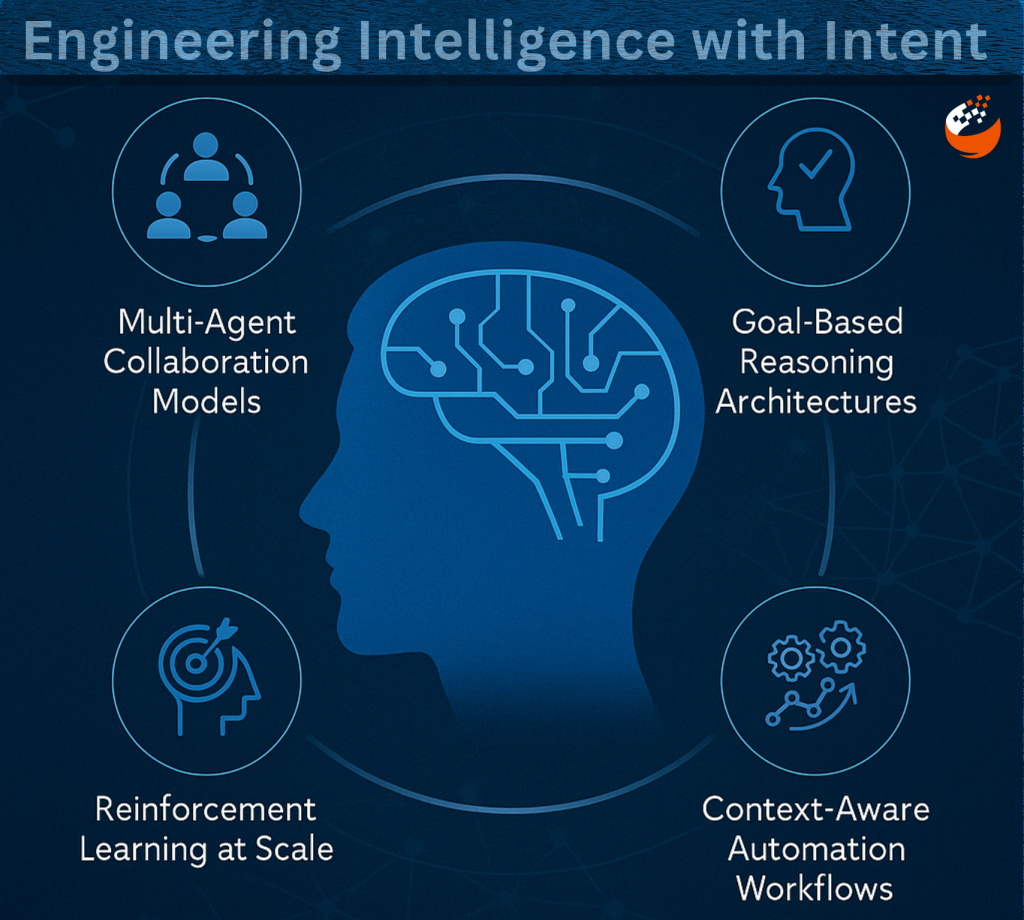
The Yugensys Perspective: Engineering Intelligence with Intent

At Yugensys, we view Agentic AI as the natural evolution of our mission — engineering intelligence with intent.

Our teams are developing solutions that combine:

  • Multi-agent collaboration models

  • Goal-based reasoning architectures

  • Context-aware automation workflows

  • Reinforcement learning at scale

These technologies are converging to create systems that don’t just process data, but pursue purpose.

By blending AI engineering, workflow orchestration, and intelligent automation, Yugensys helps enterprises build systems that not only respond to the world — but reshape it.

Yugensys AI Engineering

Our Services

Book a Meeting with the Experts at Yugensys


The Road Ahead: From Autonomy to Agency

Agentic AI is still in its early stages — but its trajectory is clear.
Just as the cloud became the backbone of digital infrastructure, Agentic AI will become the backbone of intelligent enterprises.

Tomorrow’s organizations won’t rely on AI assistants — they’ll rely on AI colleagues.

The transition from command-based systems to goal-driven ecosystems represents one of the most profound shifts in the history of technology — and it’s already underway.

At Yugensys, we’re not just witnessing that change — we’re helping engineer it.

Conclusion: When AI Becomes an Ally

The rise of Agentic AI marks the moment AI crosses from being a system we use to a system that works with us.

It’s intelligence that doesn’t wait.
It acts — continuously, contextually, and consciously aligned with outcomes.

The organizations that will lead this era are those that empower AI not just to execute, but to exercise judgment.

And that’s where the next decade of innovation will be defined.

Picture of Vaishakhi Panchmatia

Vaishakhi Panchmatia

As the Tech Co-Founder at Yugensys, I’m driven by a deep belief that technology is most powerful when it creates real, measurable impact. At Yugensys, I lead our efforts in engineering intelligence into every layer of software development — from concept to code, and from data to decision. With a focus on AI-driven innovation, product engineering, and digital transformation, my work revolves around helping global enterprises and startups accelerate growth through technology that truly performs. Over the years, I’ve had the privilege of building and scaling teams that don’t just develop products — they craft solutions with purpose, precision, and performance.Our mission is simple yet bold: to turn ideas into intelligent systems that shape the future. If you’re looking to extend your engineering capabilities or explore how AI and modern software architecture can amplify your business outcomes, let’s connect.At Yugensys, we build technology that doesn’t just adapt to change — it drives it.


Subscrible For Weekly Industry Updates and Yugensys Expert written Blogs


More blogs from Artificial Intelligence

Delve into the transformative world of Artificial Intelligence, where machines are designed to think, learn, and make decisions like humans. This category covers topics ranging from intelligent agents and natural language processing to computer vision and generative AI. Learn about real-world applications, cutting-edge research, and tools driving innovation in industries such as healthcare, finance, and automation.


Expert Written Blogs

Common Words in Client’s testimonial