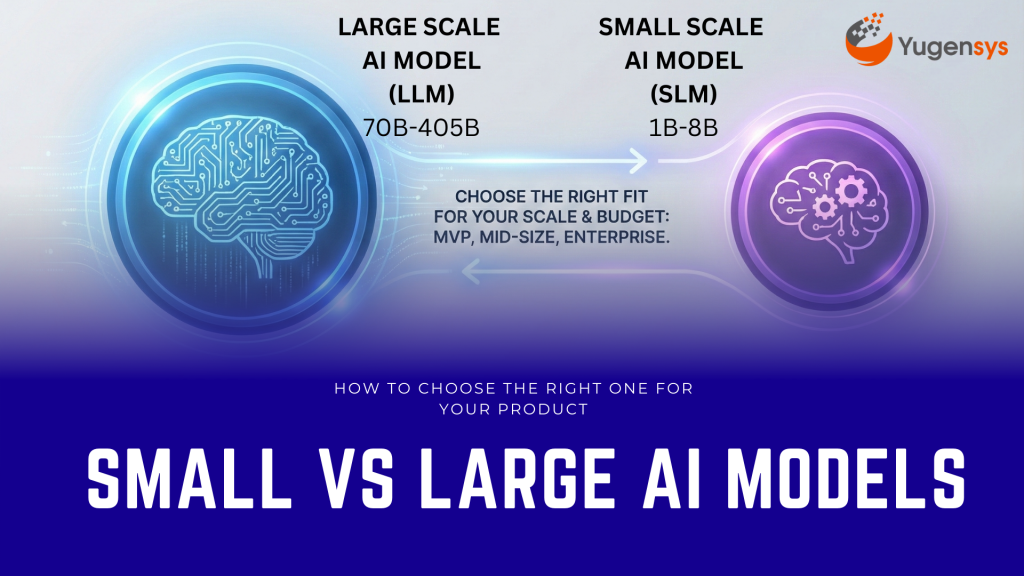
Small vs Large AI Models: How to Choose the Right One for Your Product 

Choosing the right AI model isn’t about picking the biggest or most powerful LLM—it’s about choosing the one that fits your product’s scale, cost, and performance needs. This guide breaks down model selection across small, mid, and large-scale deployments, with clear recommendations for startups, growing products, and enterprise-grade systems. Learn when to use lightweight 7B models, fine-tuned 30B models, or high-end 70B+ models, and how to balance accuracy, latency, cost, and compliance to make the smartest AI architecture decisions.

Table of Contents

Speed Is an Architecture Decision

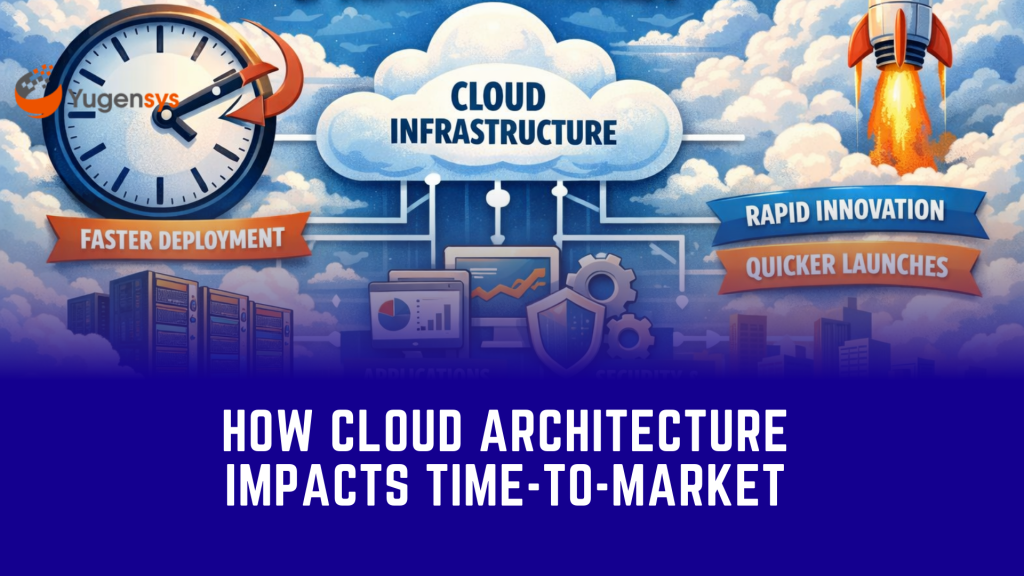
Time-to-market is often framed as a delivery issue. For leadership, it is more so an architecture decision.

Organizations slow down when platforms are hard to change, releases require leadership sign-off at every step, or early design choices limit later decisions. In these situations, speed is limited not by execution effort, but by the cost of change. Cloud architecture affects time-to-market by lowering that cost and allowing business priorities to be acted on without structural delays.

When cloud foundations are designed with intent, releases shift from infrequent, high-risk events to smaller, predictable updates. Changes can be introduced without reworking core systems, which gives leadership clearer timelines and the ability to respond to market or customer signals without disrupting ongoing operations.

Small vs Large AI Models: How to Choose the Right One for Your Product
Faster Releases Through Better Risk Management and Consistency

Cloud architecture also reshapes how risk is managed. Performance, scalability, and reliability issues are identified earlier in the lifecycle, when they can be resolved without last-minute trade-offs. This reduces late-stage surprises and makes launches more controlled, rather than compressed under pressure.

As organizations scale, speed alone is insufficient. Consistency becomes a leadership requirement. Cloud-based platforms enable common delivery patterns across teams and regions, reducing dependency on individual execution styles. For CXOs, this translates into greater predictability across initiatives, better portfolio-level planning, and fewer delivery escalations.

Yugensys View: Architecture Aligned to Business Outcomes

In practice, Yugensys has seen time-to-market improve when architectural choices are made with business outcomes in mind, not treated as mere implementation. Across product launches and modernization programs, this has typically resulted in:

    • Platforms structured to validate direction early, allowing leadership teams to confirm priorities before committing significant time or capital

    • Existing systems updated in specific high-impact areas, so releases become faster and more predictable without disrupting stable operations

    • Cloud foundations built to support growth when it occurs, rather than forcing premature investment

    • Cloud architecture does not guarantee speed. But when aligned with business priorities, it removes many of the reasons products fail to reach the market on time.

At Yugensys, this alignment is treated as a discipline – one that helps leadership teams move with confidence, not urgency.

Our Services

Book a Meeting with the Experts at Yugensys


Subscrible For Weekly Industry Updates and Yugensys Expert written Blogs


More blogs from Data Infrastructure

No description found for this category.

Small vs Large AI Models: How to Choose the Right One for Your Product 

Small vs Large AI Models: How to Choose the Right One for Your Product

Choosing the right AI model isn’t about picking the biggest or most powerful LLM—it’s about choosing the one that fits your product’s scale, cost, and performance needs. This guide breaks down model selection across small, mid, and large-scale deployments, with clear recommendations for startups, growing products, and enterprise-grade systems. Learn when to use lightweight 7B models, fine-tuned 30B models, or high-end 70B+ models, and how to balance accuracy, latency, cost, and compliance to make the smartest AI architecture decisions.

Top 5 AI and Startup Trends from GITEX 2025, Dubai — The Future Is Already Here
Top 5 AI and Startup Trends from GITEX 2025, Dubai – Yugensys

Dubai — Where the Future Comes to Meet the Present
When more than 6,000 global technology companies and 2,000 AI startups converge under one roof, innovation moves from concept to reality.
That is precisely what unfolded at GITEX & Expand North Star 2025, where artificial intelligence, software startups, and digital products defined the next era of intelligent systems.
Across every panel discussion, product demo, and investor conversation, one message was clear: AI is no longer experimental; it is operational.

A Developer’s Guide to Automated Code Generation with AWS Bedrock
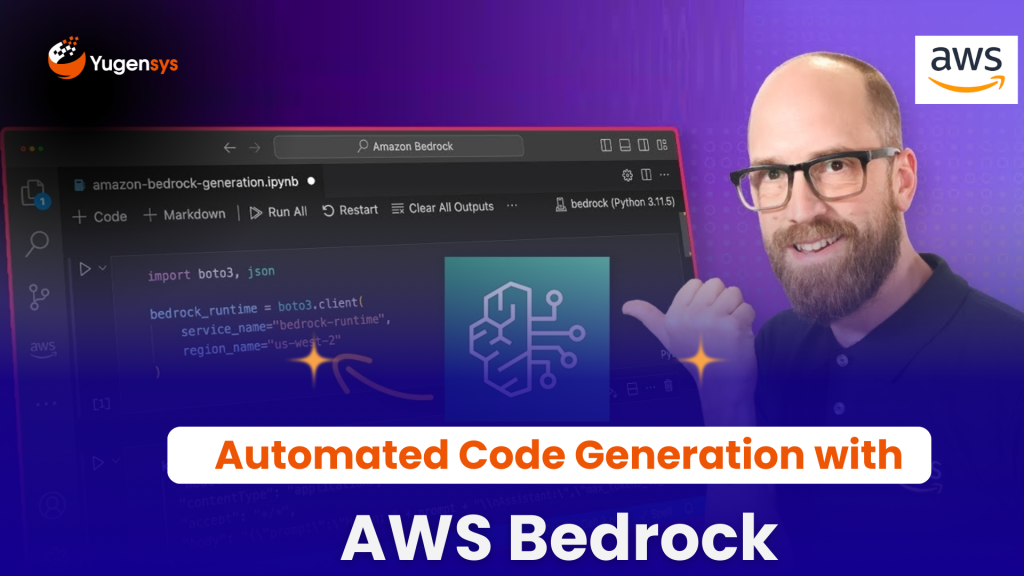
Home / Blogs Artificial Intelligence Table of Contents   In the ever-evolving landscape of software development, automation is becoming a cornerstone for boosting productivity and enhancing innovation. In this blog, we delve into the transformative potential of AWS Bedrock for modern developers.  From streamlining routine coding tasks to leveraging the power of generative AI for […]

Integrating Gen AI into Dart: A Beginner’s Approach
This beginner-friendly guide walks you through the process of integrating generative AI (Gen AI) into Dart. You’ll explore the essential tools, key components, and practical steps to set up your environment, connect AI models, and enhance your applications with AI capabilities. Whether you’re a developer new to AI or Dart, this guide will provide you with a solid foundation to kickstart your journey.

Getting Started with ML.NET for Predictions
In this beginner’s guide, you’ll discover the basics of ML.NET, Microsoft’s open-source machine learning framework designed for .NET developers. This guide will cover the steps for setting up ML.NET, building a simple predictive model, and understanding key algorithms that power predictive analytics. By the end, you’ll have a solid foundation to start integrating machine learning into your .NET applications.

Expert Written Blogs

Common Words in Client’s testimonial